
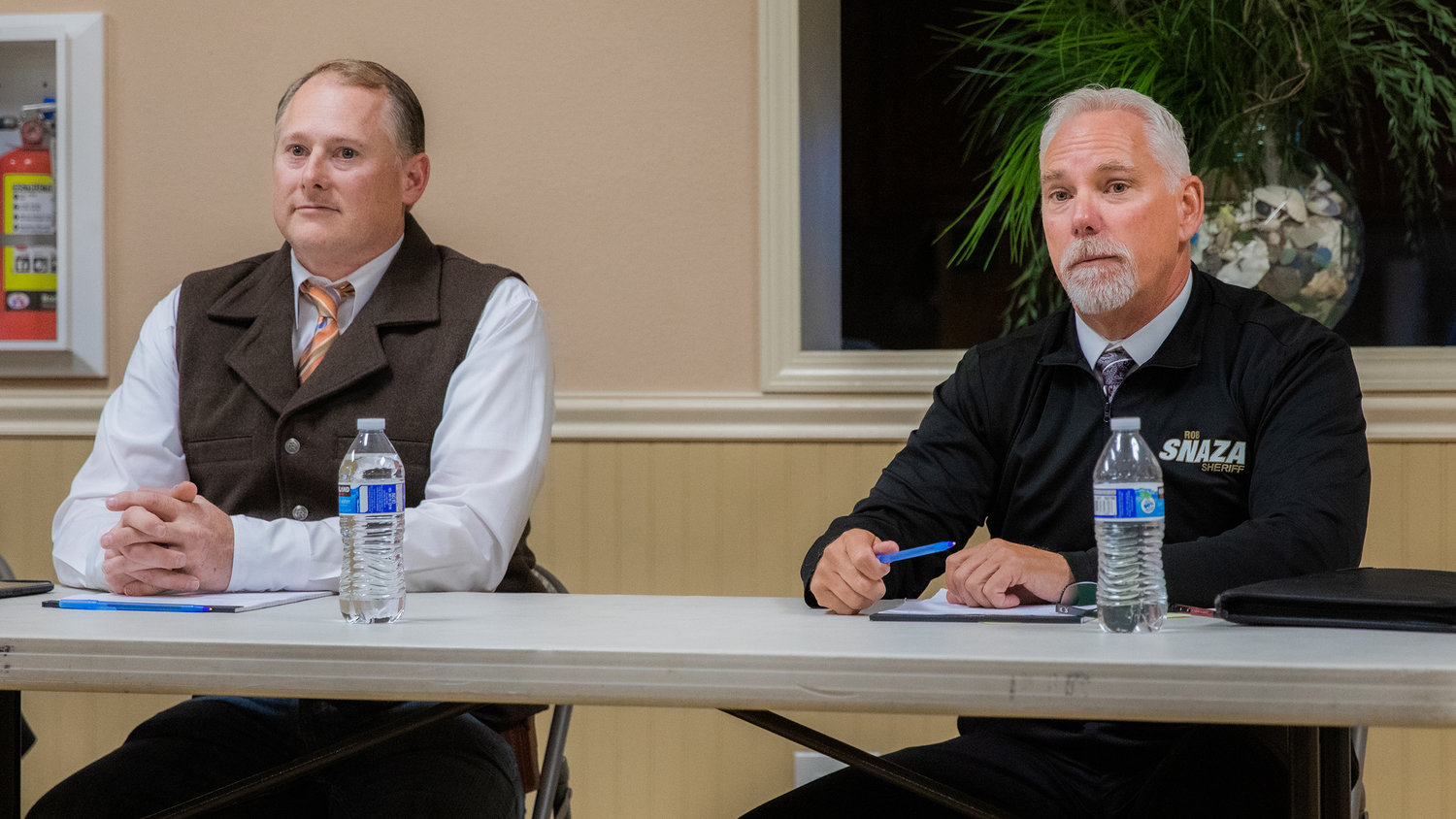





Editor’s note: The Chronicle spoke with Lewis County Sheriff Rob Snaza in a wide-ranging phone conversation covering the achievements, challenges and controversies that defined his tenure. In part one of the two-part series, the sheriff speaks on the fallout of former Centralia Police Sgt. Tracy Murphy’s firing and allegations that Snaza protects drug dealers.
Lewis County Sheriff Rob Snaza has kept a low profile this year.
But as his third term leading the Lewis County Sheriff’s Office (LCSO) enters its final months — and as controversy and rumor continue to swirl around the fired Centralia police sergeant who implicated him in a cocaine conspiracy — the retiring sheriff believes now is the time to speak.
As Snaza puts it, “This is not how I want to go out.”
The sheriff has often been mentioned in the local media and on social media since Tracy Murphy was fired in April after Centralia Police Chief Andy Caldwell concluded he’d made false statements while omitting material information during an internal investigation.
The investigation stemmed from an anonymous complaint submitted to the Washington state Criminal Justice Training Commission (CJTC) in January. The complainant alleged Murphy had made “repeated statements” claiming Snaza acquires and protects drug dealers, who then distribute cocaine to prominent area Republicans.
At the time, Murphy led the now-defunct Joint Narcotics Enforcement Team (JNET).
The complainant believed Murphy was spreading the unverified information to possibly “gain leverage” in his campaign to become sheriff after losing to Snaza in the 2022 general election.
Murphy finished second in the August 2026 primary election behind LCSO Special Services Chief Gabriel Frase. The two will face off in the Nov. 3 general election.
Though the private investigator hired by the Centralia Police Department determined he could not sustain the allegations against Murphy, he did take issue with Murphy’s “categorical denial” that he made statements suggesting Snaza protected drug dealers.
The denial contradicted several witnesses within the department, who reported having discussions with Murphy about associates of Snaza possibly being involved in drug activity, as well as discussions about Snaza either protecting or choosing a policy of “non-enforcement.”
Snaza said he’d been aware of rumors that the sheriff’s office allows drug activity to occur in the county since the last election cycle.
“It's not that we're not doing anything,” Snaza said. “It's just the resources that we have. We do what we can to go after those individuals. So, the one thing that really upset me was because I spent my career going after those individuals involved in drug activity my whole life.”
Snaza described being a young Napavine officer working for the county’s ProAct Unit, and then later supervising the Unified Narcotics Enforcement Team (UNET), a precursor to JNET.
“I spent a career going after those people who do evil with drugs and getting people addicted to drugs and going after drugs,” Snaza said. “So when I hear that… it challenges me because people who know me know that's not true.”
Speaking to The Chronicle in February, Snaza called the CJTC complaint “frivolous” and “unfair,” and said he’s known Murphy “almost his whole law enforcement career.”
In a February news release, the “Tracy Murphy for Sheriff” campaign called the anonymous complaint “politically motivated.”
“This investigation is going to go nowhere because there is nothing,” Snaza said in February. “But I just say that, you know, when you're running for office or you're in office as sheriff, people are going to say a lot of things about you that aren't true.”
On Thursday, Snaza said he didn’t hear from Murphy after Murphy first became aware of the complaint. That gave Snaza pause — considering Murphy had reached out to the others named in the complaint — but he said he knew Murphy wasn’t required to call anybody.
“And then I find out that there's deception, and that he's under investigation, and that he lied — and he did,” Snaza said. “You can't change one report and go to another and say, ‘Well, I fell under a non-disclosure agreement.’”
Snaza said Murphy was required to answer all questions as an employee of the City of Centralia. Worst case scenario, he could’ve sought advice from his union representative.
“If you're in the middle of those interviews, you can look at your union rep and you can say, ‘Hey, can we stop this right now? I have a concern,’” Snaza said. “That never happened. Instead, he continues on.”
Murphy later cited a non-disclosure agreement he’d signed with the Drug Enforcement Administration (DEA) prohibiting him from disclosing information without authorization. At the time, the DEA was part of JNET. Murphy told The Chronicle after his firing that the information he’d initially withheld pertained to a federal investigation, not a JNET investigation.
Snaza said Murphy’s initial denials nonetheless contradicted the other interviewed witnesses, who said, in Snaza’s words, "Oh yeah, we talked about this all the time.”
“And it was disheartening,” Snaza said. “And I know Mr. Murphy. He's been in law enforcement for 30-plus years, and he's done some good stuff. I don't want to take that away. And he's got a good family. But here's the other thing: There are a lot of good families out there. I have a good family.”
Snaza spoke to the now-infamous sticky notes posted on Murphy’s cubicle wall. The notes, which were first released redacted and then later unredacted in subsequent records requests, revealed a list of names and identifying information.
Each note labeled the individual’s possible connection to illegal drug activity, with titles such as drug user, transporter, supplier and money launderer.
A sticky note with Snaza’s name was placed at the top.
“They have their name, their date of birth… and some of those people I know personally, and some of those people were supporters of mine,” Snaza said. “Other people that were named on that are people I don't know personally, but I know there's law enforcement officers on that list — prior and current officers. I know that there's ex-wives of individuals, ex-girlfriends of individuals, all these things.
“And you don't say things like supplier, money launderer, user, distributor, and then my name's at the top, and not say or not believe that I'm involved in criminal drug activity.”
Snaza questioned why people weren’t asking about the families of those individuals, some of whom Snaza said are prominent members of the community who have contributed through their businesses, donations and support.
“What are they supposed to tell their family members?” Snaza said of the named individuals. “No one's asking about that. And that's my frustration.”
In a video posted to his campaign’s Facebook page on Oct. 4, Murphy said the sticky notes were “generated from a DEA complaint that came in in 2025.”
“The sticky notes are solely just investigative notes for the onset of an investigation,” Murphy said. “... The names that are on there don’t necessarily mean that they’re part of nefarious activities or that they’re even being looked at as a suspect in anything, and that includes Sheriff Snaza. Two people were named in the original complaint. These are just associates.”
Murphy said the individuals were identified through police reports with the Centralia Police Department, Chehalis Police Department, the LCSO and “other reports in the DEA system.”
In the video, Murphy said he never investigated Snaza, and as far as he knows, neither has JNET, the Centralia Police Department or the DEA.
Snaza disputes Murphy’s characterization of the sticky notes, calling it simply an “org chart.”
“I've been around as long as Mr. Murphy and a little bit longer,” Snaza said. “That is an org chart. Now you can deny that … But when you have their name, their date of birth, what you suspect them to be doing, and phone numbers, that's kind of an org chart, and I guarantee you, you don't put something like that together and just say, ‘You know, we're just looking.’”
Snaza said he was frustrated Murphy used federal agents, state agents and Centralia detectives to “investigate or summarize” that he and the named individuals were involved in cocaine delivery or distribution.
“And that is so false,” Snaza said, adding he believes the investigation was "malicious."
“And I honestly think that he did it for his own purposes,” Snaza said. “And if he was doing it for the betterment of the community and everything, then he should have told his command team. He should have told his chief what was going on, and his chief would have taken over the investigation and probably handed it out.”
When asked if he felt any frustration toward the City of Centralia for releasing the unredacted notes, Snaza expressed disappointment, but said the city’s attorneys “are the ones that allowed them to put that out, and that kind of stuff doesn't bother me.”
“I think if you were to ask Chief Caldwell or whatever if he wishes things were different, I guarantee he would tell you he wishes things were different,” Snaza said.
Snaza said later he believed Caldwell “did everything right that he could once he realized there was an issue.”
In July, Snaza announced he’d requested state and federal investigations into the allegations of his own involvement in organized crime and narcotics trafficking.
Snaza made the announcement in two letters addressed separately to the CJTC and the Lewis County Board of Commissioners (BOCC).
In his letter to the BOCC, Snaza said he’d requested the FBI, the DEA Seattle Field Division and the CJTC “look into this matter and determine if a thorough investigation is warranted.”
Snaza told the CJTC he’d requested the investigation “in the interest of restoring public trust.”
On Thursday, Snaza said he’d also reached out to the Washington State Patrol (WSP) and the Washington state Attorney General's Office. He said the WSP and the CJTC told him they would not investigate. He said the FBI’s office in Seattle told him they’d received his letter. Snaza said he hasn’t heard back from the attorney general’s office or the DEA.
The sheriff also noted the people who have come forward in the months since Murphy’s firing to allege that Murphy — or his spouse — had accused Snaza of protecting drug dealers. Those include Port of Centralia Commissioner Ally Pickard, Lewis County Clerk Scott Tinney and Lewis County Commissioner Sean Swope.
Caldwell has cataloged their reports in memorandums added to Murphy's administrative investigation file. Murphy has denied making the allegations to Tinney or Swope.
The former sergeant is scheduled for an arbitration hearing in November between his union representatives at Teamsters Local 252 and the City of Centralia to contest his firing.
“I know that the union wouldn’t be spending as much money as they’re spending to defend me and get my job back if they even thought that I was in the wrong,” Murphy said in a video posted to his campaign’s Facebook page on Sept. 17. “So, we know the truth, and we know that it will come out.”
Snaza said he believes Murphy was rightly fired, but said the hearing — regardless of the outcome — won’t “alleviate” the potential impeachment disclosure (PID) issued by Lewis County Prosecutor Jonathan Meyer in May.
A PID, known informally as a Brady letter, is used to disclose to a criminal defendant information about a government witness that may be exculpatory or impeaching. Brady lists also serve as an unofficial record of those found to have engaged in misconduct.
“And it doesn't change the fact that he's going to be investigated by CJTC for lying in an investigation,” Snaza added.
The complaint that led to Murphy’s firing remained in the “intake review” stage as of last month. On Thursday, Snaza said the CJTC complaint is currently “in the queue.”
Any potential CJTC investigation is followed by an administrative review, a statement of charges, if necessary, and, finally, an administrative hearing where the officer can argue against the commission’s decision to revoke or suspend their certification.
Snaza expressed concern if Murphy were elected sheriff.
“If he was willing to take a task force, a JNET task force, without telling any administrators what he was doing and doing this, what would he be capable of doing if he was sheriff?” Snaza said.
Snaza said he believed Murphy was coming after him with an “evil intent.”
“And I don't look at it any other way,” Snaza said. “And I rely on my faith as much as anybody else. But I can tell you this: it's disheartening.”
Snaza further questioned the likelihood of any large-scale cocaine distribution scheme existing in Lewis County, saying heroin, methamphetamine and fentanyl were far more prevalent.
“Put it this way, cocaine is not the prevalent drug of Lewis County,” Snaza said.
The sheriff acknowledged he’s “probably going to catch some flack” for talking about the situation, but said, “I do think it needs to be out there.”
Speaking to the allegations against him, the sheriff denied any protection or non-enforcement of cocaine dealing, saying he’d arrest “every single one of those people on that paper” if they were involved in “any type of illegal activity like that.”
“I would arrest them because I have not lost my morals or ethical values,” Snaza said. “I still hold them to the highest integrity, and as your sheriff, I would never allow that kind of stuff to happen. Never. That's what bothers me.”



