TULALIP — The grand prize of the Coin Combo slot games at the Tulalip Resort Casino ticked upward from $10,600 before a trio of women perched in their seats, each hopeful that she would be the one to win the jackpot. Feeding the slots, they became part of the gaming house’s labyrinth of colors and noises.
The casino, which is owned and operated by the Tulalip Tribes, bustled with activity on a winter afternoon. Outside, every tree and shrub dripped with string lights, beckoning commuters from the property’s position near Marysville along the gridlocked Interstate 5 corridor: Come and stay a while.
The Tulalip Tribes are among several Washington tribes with thriving casinos, in stark contrast to the recent struggles of some local and national gambling business operators. Kirkland-based gaming company Maverick Gaming filed for bankruptcy in July, shuttering four card rooms in the Seattle area. Even Las Vegas, long considered the country’s gambling capital, has faced a downward spiral, with falling tourism tied to the ongoing economic squeeze on American wallets.
Casinos in Washington — where Native American tribes are the industry’s keepers — have largely weathered the storm. Leaders of several tribal-owned gaming houses say business remains stable as they build upon a solid foundation of self-determination and autonomy from commercial investors. Meanwhile, sports betting is attracting a younger crowd ready to place wagers on teams.
Still, the state’s gambling scene isn’t immune to all headwinds.
Employee turnover and job growth are persistent obstacles for the casino industry, and some local gaming entities are seeing fewer visits from guests “whose entertainment dollars must now be allocated to meet the rise in costs for needs such as groceries and gas,” said Tulalip Gaming Organization President Marci Fryberg, an enrolled member of the Tulalip Tribes.
The future of these casinos matters to the tribes: Not only do they provide work opportunities, but the gambling establishments also create capital that goes toward infrastructure, housing, enterprise, government operations and more.
“When you follow the money, you see that it’s doing really important work in really important communities that are benefiting Washington,” said Rebecca George, executive director of the Washington Indian Gaming Association and citizen of the Port Gamble S’Klallam Tribe on the Kitsap Peninsula.
Gambling dollars
In Washington, gamblers with an itch to test their luck can venture to tribal-owned casinos or commercial card rooms, as well as play the state lottery system.
Here, 22 tribes operate gaming properties, and seven tribes do not, George said. “While not every tribe operates a property, every tribe in Washington benefits from gaming dollars.”
She explained that the local intertribal system is set up so the gaming economy reaches all corners of the state — not just the gambling tribes.
The catalyst for tribal gaming can be traced to 1986 with a case, California v. Cabazon Band of Indians, argued in the U.S. Supreme Court. The 1987 decision found that states cannot regulate tribal gaming. The next year, Congress enacted the Indian Gaming Regulatory Act, which built out the federal regulatory framework. Tribal gaming kicked off in the 1990s.
“For Indian Country, our casino revenue goes to backfill trillions of dollars of unfunded mandates throughout history,” George said. “Gaming has been the first access to capital that we have had.”
It’s helped tribal populations climb out of poverty, she said, and has gradually improved health care, education and socioeconomic conditions.
“Over the last 30 years, American Indians on reservations in Washington saw their real income per person rise 59%,” per the Washington Indian Gaming Association.
It said tribal revenue created the Lummi Nation’s Northwest Indian College, the Swinomish Indian Tribal Community’s didgʷálič Wellness Center and the Tulalip Tribes’ Lushootseed Language Department.
The Tulalip Tribes have had a hand in gaming since signing a compact with the state in 1991 — the first to do so. The tribes’ first casino opened in 1992, President Fryberg said. Six years later, slot machines were introduced.
That “gave tribes a path to self-sufficiency by significantly increasing gaming revenue, which directly benefitted tribal governments,” Fryberg said.
The Tulalip gaming organization now includes three entities — Tulalip Resort Casino, Quil Ceda Creek Casino and Tulalip Bingo and Slots — and a hotel. Funds from the business entities are invested in housing, education and job opportunities for tribal members, Fryberg said.
Washington’s gambling industry has a little room for commercial players, too, but those opportunities are strictly defined.
Bars and taverns can sell pull tabs, and card rooms can run table games, but “casino gaming is exclusive to the tribes,” state Sen. Steve Conway said in a phone interview. The Democrat representing a Pierce County district serves in a nonvoting capacity on the Washington State Gambling Commission.
Washington is “unique,” said Conway, who is not Native. “We’re not a Nevada-style gaming state.”
The difference between commercial and tribal enterprises can be striking in the gaming industry. Yale Rowe, CEO of Emerald Queen Casino, would know.
Emerald Queen Casino is owned and operated by the Puyallup Tribe of Indians, which finalized its original tribal gaming compact in 1996. It consists of two properties in Pierce County: one in Fife, which opened in 2004, and another in Tacoma, which opened in 2020.
Rowe, who is not Native, previously worked for First Nation casinos in Canada and a tribal casino in California. He also has experience in the commercial industry in Nevada’s Lake Tahoe and Las Vegas.
At commercial casinos, “it’s kind of a dog-eat-dog business that’s very competitive, very aggressive,” he said.
But in Washington, hedge funds don’t play a role in decision making at tribal businesses.
“You’re not living in these 90-day cycles where you’re constantly trying to make sure that you’re hitting these short-term windows for Wall Street or for the investment community,” Rowe said. “Here, we’re able to take a much longer view — three to five years — where we’re thinking about the future.”
Tribal facilities also hold more appeal to some local gamblers.
Carolyn Youngker, a 64-year-old Port Orchard resident, prefers to gamble at tribal casinos — the Suquamish Tribe’s Clearwater Casino Resort and the Port Gamble S’Klallam Tribe’s The Point Casino & Hotel among them — because of their amenities. She recently visited Emerald Queen Casino to see a show.
As for commercial card rooms, “they’re definitely not for me,” Youngker said. Even when she frequently played Texas Hold ’em poker in the 1990s, she didn’t enjoy the card room experience because “they’re stuffy, and there’s nothing else there.”
‘Plenty of business to go around’
Financially, the casino industry is navigating a changing landscape.
Phil Bernard, managing director of gaming equipment and technology at Eilers & Krejcik Gaming, a boutique research and consulting firm in Newport Beach, Calif., focused on the gaming industry, said the sector at large hasn’t suffered from macroeconomic pressures quite yet.
“Everyone is waiting for the shoe to drop,” he said in a phone interview, “but we’ve all been waiting for the shoe to drop in the economy for years now.”
Bernard explained that lower income brackets are feeling the most strain right now. “The top tier, maybe VIP, players — no impact whatsoever,” he said.
In many markets, casino visitation is down, Bernard said, but the players who continue to frequent gaming houses are spending more.
He pointed to slot machines as the overwhelming majority of a casino’s business. In the U.S. and Canada, slot revenue jumped 5% year over year in the third quarter of 2025, according to Eilers & Krejcik Gaming’s Gaming Revenue Brief. Similarly, total gaming revenue for both North American countries saw a 6% increase year over year.
Bernard believes prominent challenges facing casinos include keeping pace with economic growth and standing out among increased competition.
“That’s the main benefit on the tribal side: There’s some insulation from competition that comes with a lot of the tribal regulations,” he said.
Nationwide, fiscal 2024 resulted in almost $44 billion in gross tribal gaming revenues — a $2 billion bump from fiscal 2023’s figure, according to the National Indian Gaming Commission.
Bernard described Washington as one of the larger tribal markets. Here, the tribes generate billions in economic activity from their businesses, including casinos.
Overall, that consists of more than $7 billion in gross state product, around $4 billion in wages and benefits and over $3.6 billion in purchasing power, according to a 2025 report on the economic and community benefits of tribes in Washington.
“We all do great,” Emerald Queen Casino’s Rowe said. “It’s a very robust market, and I think there’s plenty of business to go around.”
Even in tough times, his casino’s patrons are choosing to stick around, he added.
They “tend to remain committed to their entertainment dollars, especially when times may get a little bit more difficult,” Rowe said. “We see them consistently — kind of through good times and bad.”
Tribes also put over $2 million annually toward fighting problem gambling through education, prevention, treatment and wellness programs, according to the Washington Indian Gaming Association.
Out of 41 commercial card rooms statewide, 39% reported a net loss in fiscal year 2024, according to financial statements published by WSGC.
The ‘new frontier’
Tribes hold the exclusive right to a new gaming venture, sports betting, which Sen. Conway referred to as “the big, new frontier of gambling.”
It’s enticed a new generation of clientele to the casinos.
That comes with a few caveats: In Washington, a sportsbook venue must be housed at its respective tribal gaming facility, and mobile sports bets can only take place on-site through geofencing, according to WSGC.
Rowe described sports betting as “white hot” at the Emerald Queen Casino, particularly among younger patrons. “I wouldn’t say it’s a significant portion of our revenue model, but it’s an important portion.”
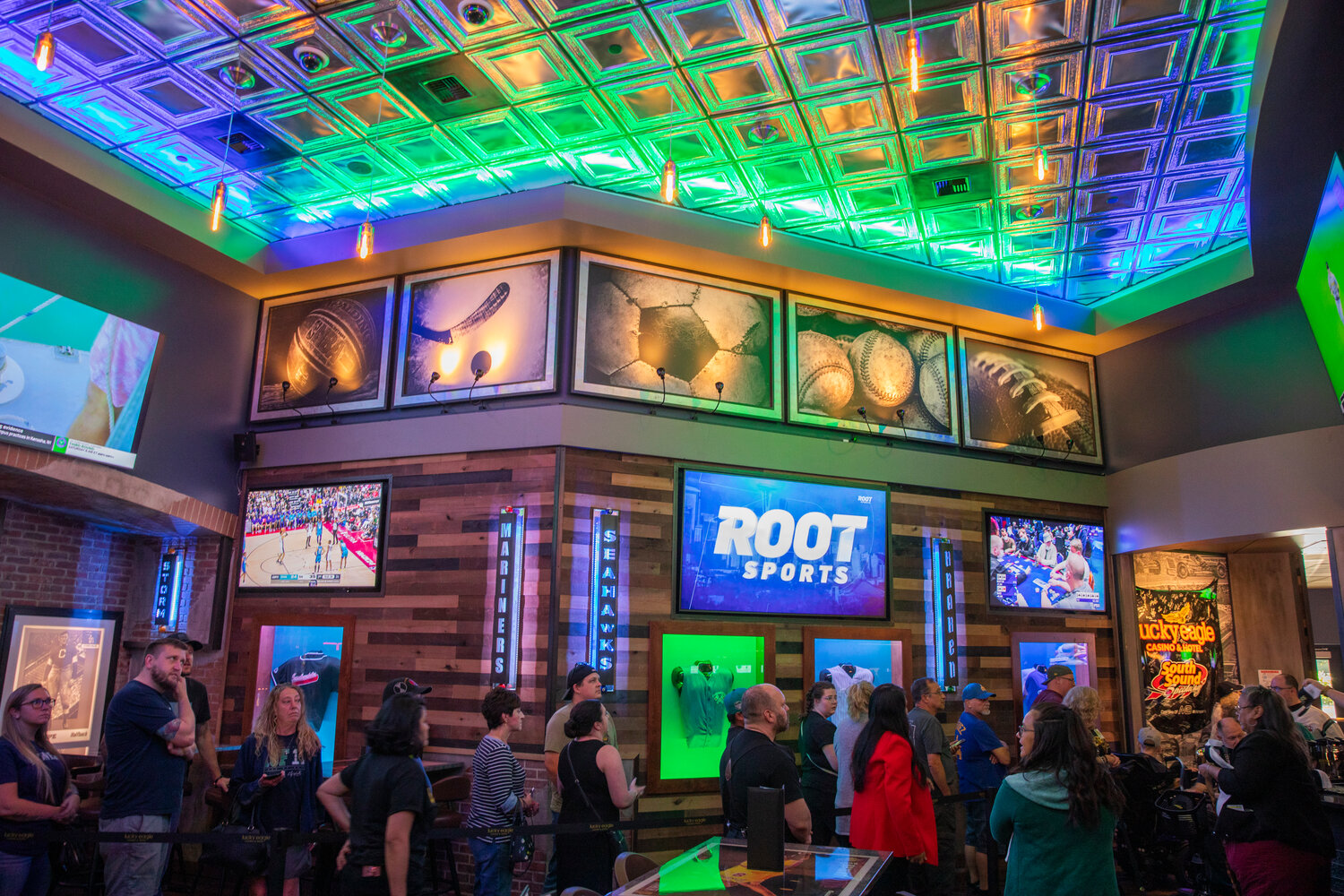
In December, at the Tulalip Resort Casino, two football games and one live feed of sports commentators played concurrently on a giant screen in the dedicated area for sports betting. More than half a dozen men lounged in club chairs and occupied nearby tables, alternating their gaze between their phones and the game highlights.
The Tulalip Tribes partnered with DraftKings, a sports betting company, in 2022, and a mobile app between the two parties went live in 2023.
“Our overall demographics have shifted slightly in favor of a younger demographic in recent years,” Fryberg said, “and we attribute some of that shift to sports betting.”
State Rep. Shelley Kloba, who is an ex officio on the state’s gambling commission, highlighted one emerging hurdle: Sports gamblers may pressure tribes to let them place bets on Washington college teams — wagers that are currently prohibited. The topic crops up every year during the March Madness basketball tournament, she said.
However, “that’s a really commonsense, protective aspect of the way we regulate sports betting,” said Kloba, a Democrat whose district includes Bothell. She is not Native.
For the Tulalip Tribes, business is “still holding steady overall,” Fryberg said. Other tribal-owned gaming houses are also staying the course.
In the rural lands of South Central Washington, Ralph Sampson Jr., tribal councilman and former tribal chairman of the Yakama Indian Nation, said Legends Casino is “holding steady.” Former Gov. Mike Lowry signed the tribe’s gaming compact in 1996.
But the gambling sector is still impacted by a few difficulties, with employment proving to be a persistent stumbling block.
In the U.S., “overall employment of gambling services workers is projected to show little or no change from 2024 to 2034,” according to the Bureau of Labor Statistics, which emphasized the “limited employment growth.”
Fryberg said the hospitality industry is “so competitive with high turnover rates.” In particular, a casino is “a 24/7 business,” she added, with unique demands like schedule commitments for holidays and shift work.
“Many tribal members prefer working with the Tulalip entities who offer more traditional work schedules that align with personal family needs,” she said.
Out of 2,300 people, 10% of the tribal gaming organization’s employees are Tulalip tribal members, though Fryberg is aiming to boost that number through education, internships and training.
Not every tribe is encountering the same dilemma.
At Legends Casino, the Yakama Indian Nation “wanted to see enrolled members employed there,” Sampson said. “The purpose of the casino was to provide employment.”
Out of around 800 employees, 51% are enrolled Yakama members, 5% are Yakama descendants and 2% are spouses of enrolled members, Sampson said. Additionally, 8% of workers are from other tribes.
The future of tribal gaming
The future of tribal gaming lies in its potential for entertainment.
Emerald Queen Casino’s Rowe envisions the casinos as destinations for dining and nightlife, concerts and comedy shows.
“We will see these properties continue to evolve,” he said. “Gaming will remain a focus, but consumers will engage with the venues differently.”
Rowe expects to see new products like electronic table games and “bold, fresh casino floors,” with high-limit rooms and dedicated theme areas.
Bernard at Eilers & Krejcik Gaming said entertainment offerings at casinos will help differentiate the gaming houses from online gambling, as the U.S. gradually embraces it.
“It seems like, so far, it’s going to be a slow roll” for online gambling, he said. Internet casino games are only currently legal in seven states — and Washington isn’t one of them.
Gaming’s prospects are also molded by opportunities like the University of Washington’s tribal gaming and hospitality management business certificate program.
First launched in 2015, the program is hosted at casinos around the state, instead of on the college campus, to give students hands-on experience, said Michael Verchot, founding director of the University of Washington’s Consulting and Business Development Center.
Almost 170 students have completed it since then, said Verchot, who is not Native.
“This year was the largest class ever that we’ve had,” said John MacClain, an adjunct professor and an enrolled member of the Confederated Tribes of the Colville Reservation in Northeast Washington. Around 30 students enrolled, and almost 10 Washington tribes were represented among them.
“Tribes really want self-determination in their casinos, and you best accomplish that by hiring your own members,” MacClain said.
Almost 30 years ago, he started his tribal gaming career as a blackjack dealer at Chelan County’s Mill Bay Casino. Since then, MacClain has built an illustrious resume, filling leadership roles at various casinos.
He currently serves as the general manager of Two Rivers Casino and Smoke Shop, a business owned by the Sauk-Suiattle Indian Tribe in Darrington.
“I owe my life and my ability to support my family to the gaming industry,” MacClain said.



