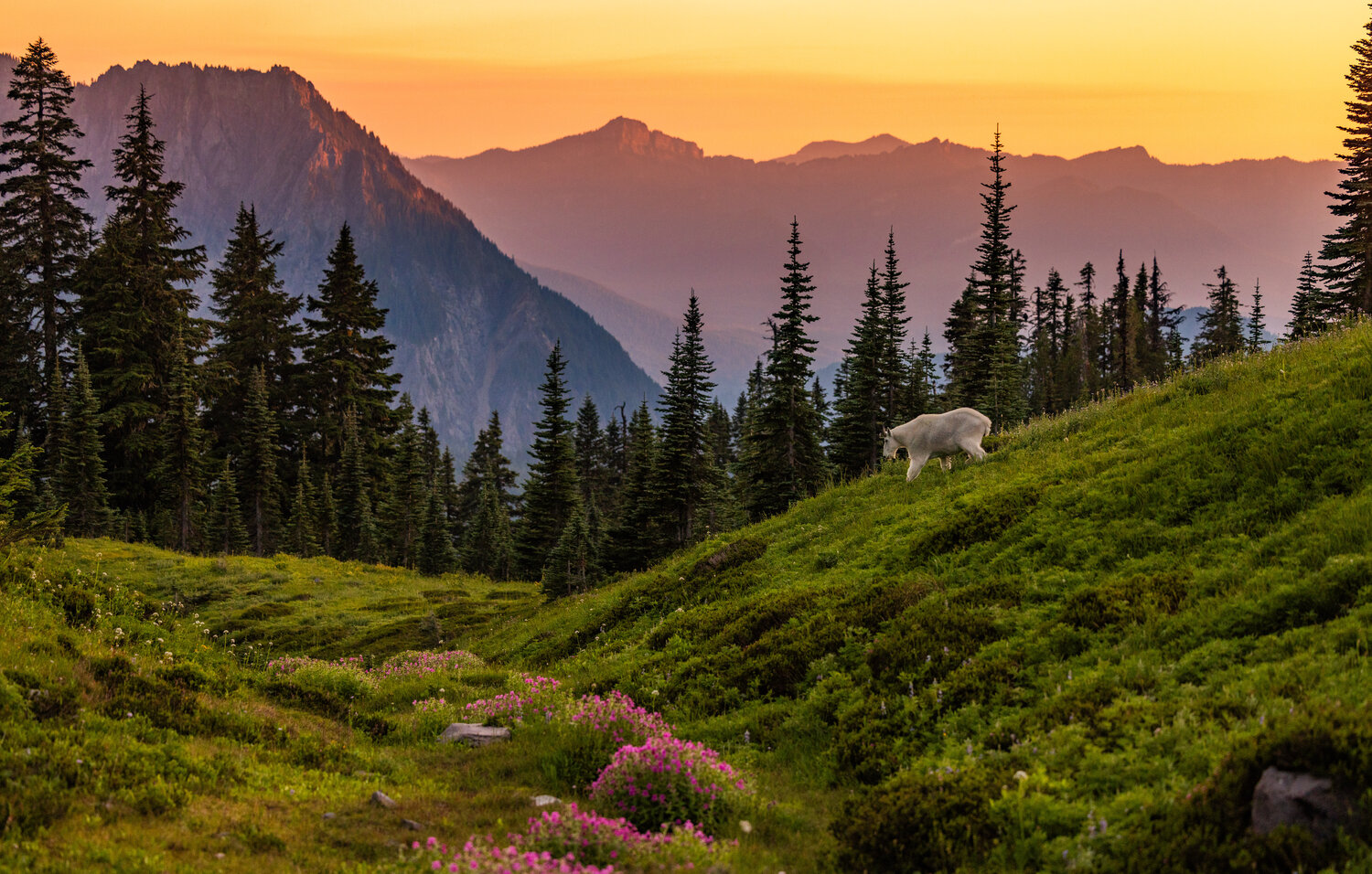




On a summer day, Mount Rainier National Park's Paradise area delivers exactly what its name promises. Its sprawling meadow on the mountain's south flank is covered in purple lupine, scarlet paintbrush and pure white avalanche lily, all backed by glaciers atop the tallest volcano in the Lower 48. Lucky visitors may hear the sharp whistle of a marmot on the wind as they walk the short trail to popular Myrtle Falls.
As they look across this glacier-carved landscape today, very few Paradise visitors are thinking about golf. But for a few short months in the summer of 1931, golfers from across the country hit the park's paths with golf spikes instead of hiking boots — teeing off on a nine-hole course in front of the mountain.
"I would not have picked it for a golf course," Martin Pool, a Washington golf historian who has spent years researching the vanished links, told SFGATE. "But it's the scenery and the view and the mountain that's just overwhelmingly beautiful."
The course was the brainchild of the Rainier National Park Company, the concessionaire that operated Paradise Inn and other visitor facilities inside the park. In the 1920s, tourists flocked to Paradise on day trips from Seattle and Tacoma, but few stayed the night at the lodge, instead retreating to the comforts of the nearby cities. Company executives believed golf — one of America's fastest-growing sports at the time — could convince visitors to linger a little longer and book a room at the inn.
Horace M. Albright, the director of the National Park Service at the time, was skeptical about having a golf course in one of the agency's crown-jewel Pacific Northwest parks but ultimately gave his approval.
"Golf is a country game not a city one. It can be justified in parks easier than tennis," he conceded, according to the book "Wonderland: An Administrative History of Mount Rainier National Park," as part of an acknowledgement of the park concessionaire's financial issues.
The experiment officially opened on Aug. 8, 1931, as Paradise Golf Course, which promoters billed as the highest golf course in the United States at roughly 5,500 feet above sea level. Designed by architect and golf course designer Roy Herbert Dobell, the nine-hole course measured 2,349 yards and took full advantage of Paradise's dramatic topography. The opening tee sat roughly 300 feet above the first fairway, every hole played downhill, and golfers who finished the ninth hole were shuttled by car back to the first tee to begin another round.
The elevation wasn't just part of the sales pitch — it was part of the game. "There is no question about it," Dobell told the Seattle Post-Intelligencer before the course opened. "The ball travels 25 per cent farther up here in the skies. I've proved it many times."
The Post-Intelligencer dubbed Paradise "golf utopia," touting the thin mountain air, the dramatic scenery and the novelty of hitting drives with Mount Rainier looming overhead. A round cost $1.50 for nine holes or $3 for unlimited play, with club rentals, caddies and even refreshments available near the first tee, according to a park brochure.
The novelty worked, at least briefly. According to the Paradise Golf Course logbook preserved by Mount Rainier National Park, roughly 200 men and women played the course during its short existence. Most came from Washington, but the register also recorded golfers visiting from Los Angeles, New York, Boston, Philadelphia, St. Louis, Niagara Falls and even Tokyo.
But golfers weren't the only ones interested in Paradise's newest attraction.
Newspaper accounts from the summer of 1931 describe a pair of black bears that regularly wandered onto the course at dusk, snapping bamboo flagsticks in half and pulling cups from the greens as if reclaiming the meadow for themselves. Deer and other wildlife routinely shared the fairways with golfers, a reminder that Paradise was still, first and foremost, a wild place.
In the end, the course's biggest obstacle was timing. The course opened during the Great Depression, when travel was quickly becoming a luxury few could afford.
"It was right at the start of the Great Depression," Pool said. "It wasn't going to turn out good. The idea had legs, that's for sure, but it just didn't come to fruition at the right time."
And even in ideal conditions, the golfing season at Mount Rainier would've been incredibly short, with the meadows seeing only a few snowless months each year. By October 1931, the mountain's slopes were blanketed with fresh snow. The course was never reopened, and wildflowers slowly took back the fairways, leaving no trace of those scenic drives into the wilderness almost a century later.
Just a few years ago, Pool and several members of the Northwest Hickory Players — a group dedicated to preserving golf's early history by playing with pre-1935 hickory-shafted clubs and period clothing — returned to Paradise to retrace the vanished course. Coordinating with park staff, they used historic blueprints and photographs to locate several of the old tees and greens, re-creating nearly century-old images where golfers once stood.
Finding the exact locations wasn't always easy. Some areas have been reclaimed by vegetation or are now closed to protect fragile alpine habitat, but a few enduring landmarks — including a prominent boulder visible in historic photographs — helped the group confirm it had found the right spots.
Standing where golfers once teed off, Pool said the landscape made it easy to understand why someone thought a golf course belonged there, if only briefly.
"If you had to build a golf course in heaven," he said, "it would have that kind of a setting."
© 2026 SFGate, San Francisco. Visit www.sfgate.com. Distributed by Tribune Content Agency, LLC.



